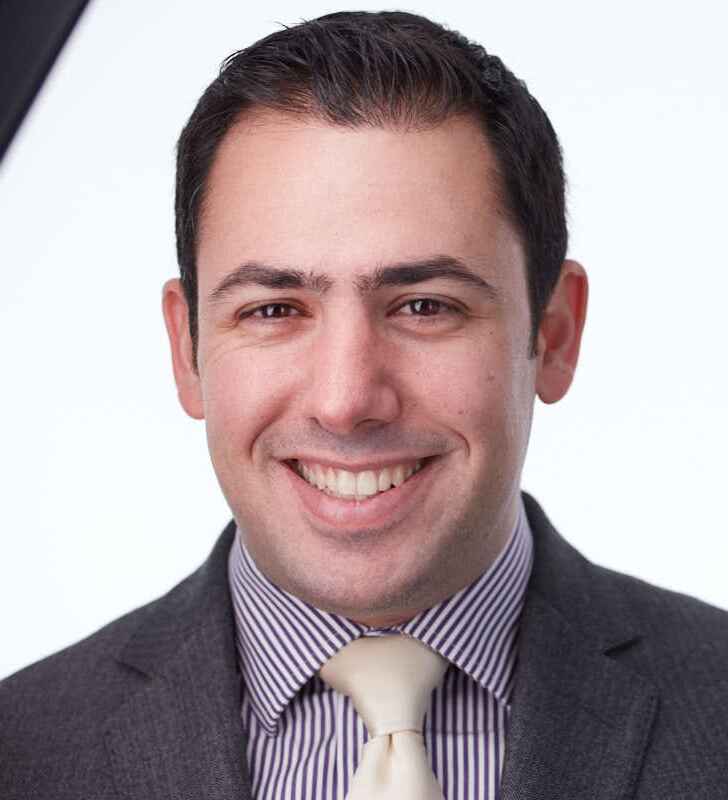
Michael Halassa MD, PhD is a Board-certified Psychiatrist who has completed his residency and fellowship training in Psychiatry from Massachusetts General Hospital/Harvard Medical School in 2014.
Michael Halassa, MD, PhD is a Professor at the Fralin Biomedical Research Institute at Virginia Tech, with appointments in Psychiatry and Behavioral Medicine at the Virginia Tech Carilion (VTC) School of Medicine and in Biomedical Engineering at the College of Engineering. He is the inaugural faculty member of the Virginia Tech Patient Research Center at VTC, where he conducts patient-based research alongside his laboratory program. He is also a board-certified psychiatrist and maintains an active clinical practice treating patients with severe psychotic disorders.
His research program, algorithmic circuit psychiatry, treats psychiatric symptoms as alterations in specific neural algorithms: particularly those the brain uses to interpret an uncertain world. The goal is to identify those algorithms precisely enough to measure them, map them onto circuits, and target them with the right interventions for the right patients.
His laboratory work established the mediodorsal thalamus as an active regulator of cognitive processing in the brain’s frontal network, overturning its long-standing characterization as a passive relay. That work, published in Nature, Nature Neuroscience, and Neuron, established the thalamus as a central node in cognitive control and a plausible target in disorders like schizophrenia. He is the sole editor of The Thalamus (Cambridge University Press).
On the clinical side, his research focuses on precision psychiatry: identifying features that allow clinicians to match patients to the right treatment and circumvent the trial-and-error that dominates real-world practice. In 2025, he published a paper in Nature Mental Health identifying clinical predictors of response to Xanomeline/Trospium, a first-in-class medication for schizophrenia, with a particular signal for negative symptoms. His lab has developed behavioral tasks in patients that track negative symptoms and can be back-translated into animal models, creating a fully integrated basic-to-clinical research program.
He completed medical school at the University of Jordan, obtained his doctoral degree in neuroscience at the University of Pennsylvania, and completed a postdoctoral fellowship with Matt Wilson at MIT while pursuing psychiatry residency at Massachusetts General Hospital/Harvard Medical School.
Prior to Virginia Tech, he was Professor and Director of Translational Research in the Department of Neuroscience at Tufts University, Associate Professor in the Department of Brain and Cognitive Sciences at MIT, and Assistant Professor at the NYU Neuroscience Institute.
His work has been recognized by the Vilcek Prize for Creative Promise in the Biomedical Sciences, the Takeda/New York Academy of Sciences Innovator Award, and fellowships and awards from the Pew, Klingenstein, Feldstein, Simons, Sloan, Kavli, Max Planck, and Brain and Behavior Foundations.
He maintains an active substack where he writes about neuroscience, psychiatry, AI and their interseciton.