Medical training teaches us to project confidence, offer quick diagnoses, and provide clear explanations. Patients come seeking answers, and there’s real pressure to have them ready.
But psychiatry lives in uncertainty. We’re trying to understand how our most complex organ system goes awry using tools that are still remarkably crude. We lack the brain equivalent of a chest X-ray, an EKG, or blood tests for kidney and liver function.
So I find myself saying “I don’t know” fairly often. And when I do, something interesting happens: patients engage more deeply in their own care, and they feel less burdened by false expectations.
Doctor, What’s my Diagnosis?
Psychiatric diagnosis is messy. The DSM looks authoritative, but anyone who uses it clinically knows how artificial those boundaries can be. For example, ruling out manic symptoms in what appears to be a mood disorder may not be straightforward because for many reasons including simple misunderstanding of what is being asked.
So… in certain situations, when patients ask “What exactly is my diagnosis?” I’ve learned to say: “I don’t know for certain right now, but here’s what I’m considering and why.”
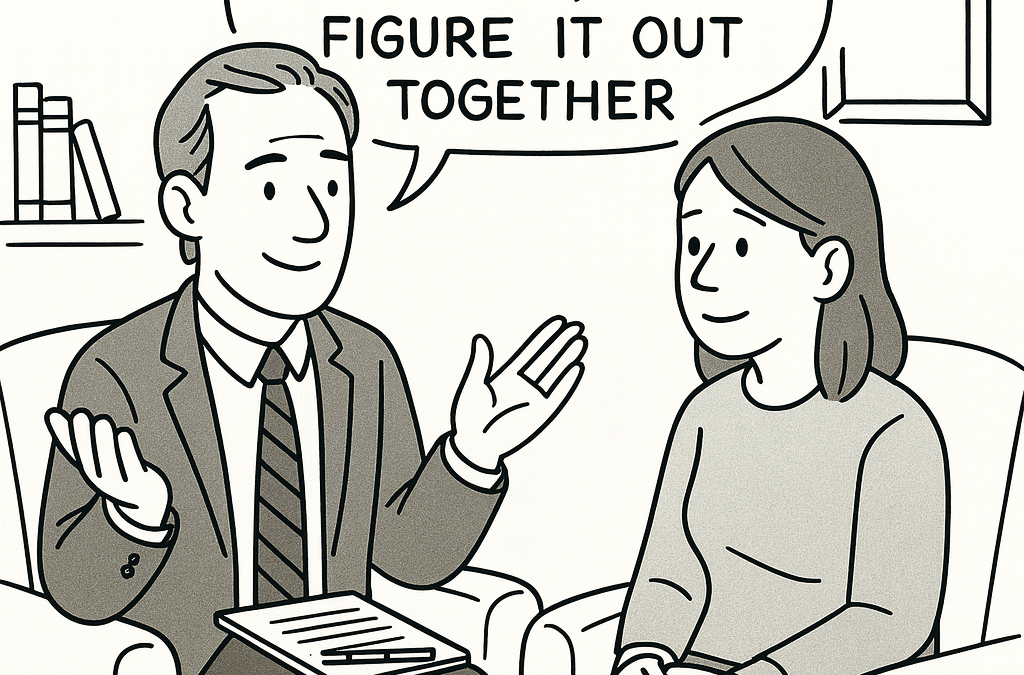
Then I walk them through my reasoning. I explain that some psychiatric diagnoses require pattern recognition over time, and that cross-sectional snapshots can be misleading. This honesty opens up space for collaboration, and we become partners trying to figure out what’s happening together.
Are you sure this is the right medication for me?
That same openness applies when we discuss medication management.
It’s a question I hear often: “Will this medication work for me?” Sometimes it’s helpful to cite studies and response rates. But in many cases, saying “I don’t know if this is the right medication for you, but I have a plan if it’s not” sets the right tone.
It shifts the conversation. Instead of setting up false expectations, we’re starting a collaborative process. The patient knows we’re learning together, which makes them more likely to give honest feedback about effects and side effects.
When a medication doesn’t work, there’s no sense of failure or broken promises. There’s just information. Valuable information that helps us understand their particular brain’s coalition of systems and move toward something more effective.
What is causing this?
The hardest question is often the simplest: “What’s going on with my brain?”
Some clinicians launch into explanations about neurotransmitters and chemical imbalances; what medical training teaches us to say. But, as I’ve written before, that level of explanation rarely connects to behavior or lived experience.
Instead, I use the coalition framework. the brain is a coalition of semi-autonomous systems, like apps on a smartphone or subcommittees in a parliament. I might say: “I don’t know exactly what’s happening, but here’s how I think about brains, and let’s figure out together which systems might be struggling.”
Then I explain that their brain is like a coalition of different systems, each optimized for specific tasks. There’s a system that tracks rewards and motivates behavior. There’s a system that builds predictions about the world and tries to minimize uncertainty. There’s an executive system that coordinates between all the others.
This gives us a framework to understand symptoms without pretending to know more than we do. Someone experiencing depression might have a reward system that’s become pessimistic about future outcomes, while their prediction system remains stuck on negative expectations. Someone with anxiety might have an uncertainty-monitoring system that’s become hypersensitive.
While not the definitive explanations patients may be used to hearing, they’re working hypotheses that connect to experience and suggest intervention strategies.
This applies to patients who may ask about “mechanism”, and I’ve learned to be honest about the limits of our knowledge while still offering useful frameworks.
The Therapeutic Power of Uncertainty
Something counterintuitive happens when you admit uncertainty: patients relax. The pressure to have all the answers immediately disappears. Instead of feeling like failures when initial treatments don’t work perfectly, they become curious collaborators.
“I don’t know yet,” followed by “but here’s how we’ll figure it out,” creates a different kind of therapeutic relationship; one built on genuine partnership, not expert authority.
I am absolutely not advocating for abandoning expertise. I still bring my training, knowledge of research, and clinical experience to every interaction. But I hold that expertise as hypotheses to be tested rather than certainties to be proclaimed.
Making Space for Learning
The coalition framework helps here too. I can explain that just as their brain is learning and adapting, our understanding of their specific brain is also evolving. Each medication trial, each therapy session, each mood tracking entry gives us more information about how their particular systems respond.
Sometimes the reward system responds quickly to interventions. Sometimes the prediction system needs more time and different approaches. Sometimes the executive system needs strengthening before other interventions can be effective.
This framing makes treatment feel less like a series of failures when things don’t work immediately, and more like a systematic exploration of their brain’s unique coalition of systems.
The Practice Transformation
Saying “I don’t know” more often has made me a better psychiatrist. It’s made my patients more engaged in their care. It’s reduced the pressure I felt to have immediate answers to enormously complex questions.
Most importantly, it’s created space for the kind of honest collaboration that actually helps people get better. When patients trust that I’ll tell them what I don’t know, they also trust what I do know.
The three words haven’t made my job easier, but they’ve made it more honest. And in a field where so much remains uncertain, honesty might be the most therapeutic thing we can offer.
Understanding starts with truth. And sometimes, the most powerful thing we can say, clinician or patient, is: “I don’t know yet, but let’s figure it out together.”