
When I wrote about Stephanie earlier this summer, the 58-year-old executive who kept photographing “dimensional breach points” in her neighbors’ basements, I discussed the potential relationship to her long-term use of prescription stimulant medication. Thirty years of stimulants had reshaped how her brain used evidence to build a model of the world. Even weeks after stopping, her psychotic symptoms persisted, challenging the traditional notion of drug-induced psychosis.
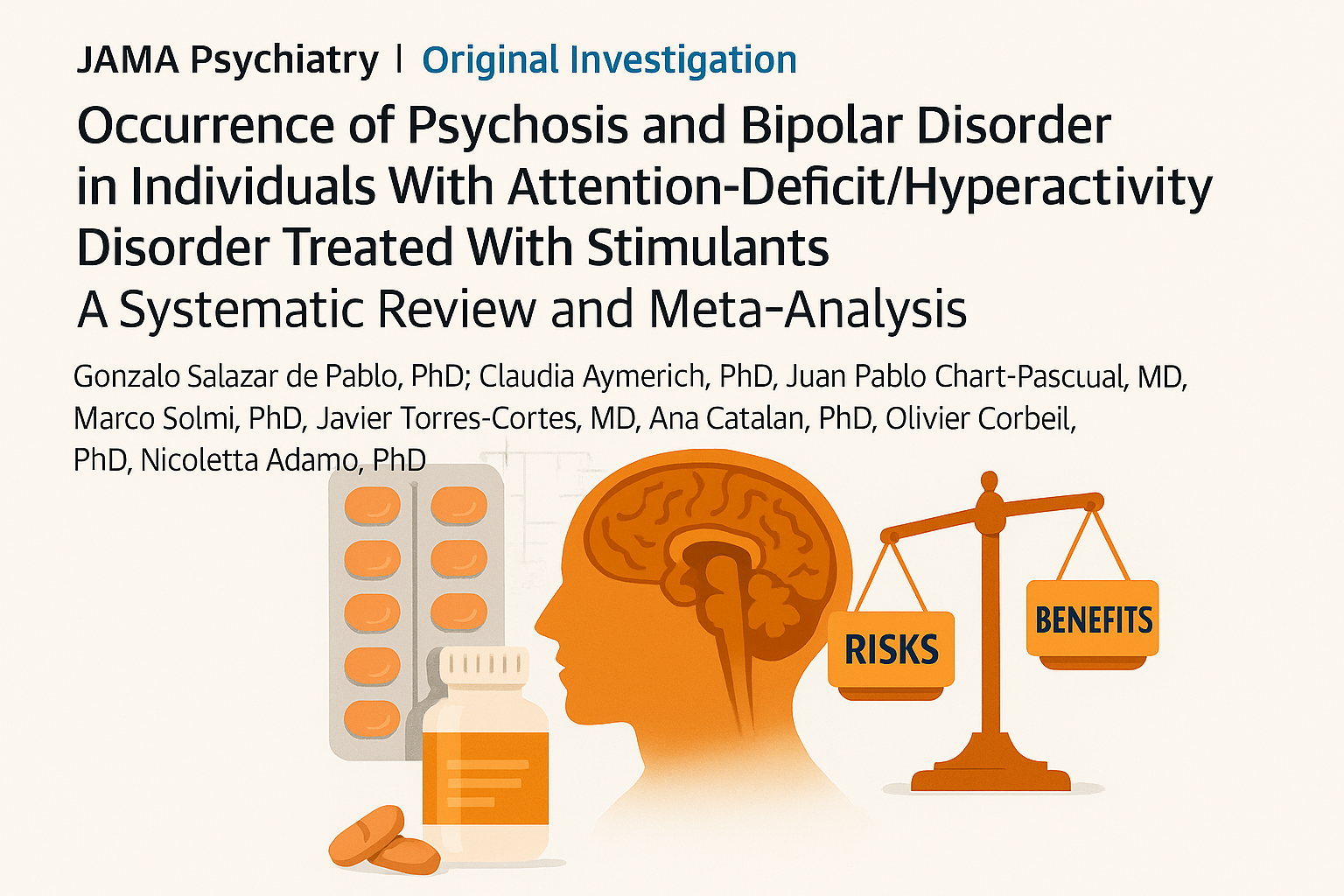
That story is no longer just anecdotal. A new JAMA Psychiatry meta-analysis quantifies what we’ve been seeing clinically.

Key Findings from the Meta-Analysis
The study represents the largest systematic review to date on this question. Researchers from King’s College London analyzed 16 studies encompassing 391,043 individuals with ADHD exposed to stimulants, spanning observational cohorts, registry studies, and clinical trials from multiple countries.
The numbers demand attention: 2.8% developed psychotic symptoms (hallucinations, delusions), 2.3% developed a psychotic disorder meeting formal diagnostic criteria, and 3.7% developed bipolar disorder. While these percentages might seem low, with millions on long-term stimulants globally, we’re talking about tens of thousands developing psychosis or mania.
Interestingly, drug type mattered: risk of psychotic symptoms was 57% higher with amphetamines than with methylphenidate (OR 1.57, 95% CI 1.15-2.16). This differential risk appeared consistent across three large studies that directly compared the medications, including an analysis of over 230,000 individuals. The finding is particularly relevant given that amphetamines (Adderall, Vyvanse) are often prescribed as first-line treatment.
But, to me, the duration effect was the most striking: in studies lasting more than 5 years, 7.2% developed psychotic symptoms, versus just 0.2% in studies under 1 year. This thirty-fold increase may change how we should think about risk, suggesting that there is a cumulative hazard rate we should be considering.
The meta-regression analyses show additional patterns. Higher risk was linked to female sex (surprising, given that psychosis generally affects males more), higher stimulant doses, and North American studies. The heterogeneity was extremely high (I² >95%), telling us that individual vulnerability varies dramatically. Some studies found near-zero risk while others found rates approaching 10%.
When “Rare” Isn’t Rare Enough
The traditional framing is that stimulant-induced psychosis is a rare side effect. With millions on long-term stimulants and a 7.2% risk after five years, we’re no longer talking about rare outcomes. Even using the conservative overall rate of 2.8%, applied to the estimated 16 million Americans taking ADHD medications, suggests over 400,000 people at risk.
Of particular significance is the study challenging assumptions about reversibility. Traditional teaching holds that stimulant-induced psychosis resolves after discontinuation. But the meta-analysis reveals that 10-25% of psychosis cases persist, with some patients transitioning to schizophreniform disorder or remaining in diagnostic limbo.
What’s important to keep in mind is that these cases cluster in older adults who’ve been on stimulants since the 1990s or early 2000s. They’re the first generation to take these medications for decades, the unintentional subjects of a natural experiment revealing risks that three-month trials could never have detected.
The Methamphetamine Parallel
The methamphetamine literature provides important guidance. Chronic recreational users show psychosis rates from 10% to 60%. The variability itself is instructive: it’s not that meth causes psychosis at some fixed rate, but that it reveals vulnerability in susceptible individuals over time.
The risk factors tell a story about different types of vulnerability. For transient psychosis, it’s earlier onset of use and male sex. For persistent psychosis that doesn’t resolve with abstinence, it’s family history of psychosis and comorbid major depression. Some brains can bounce back from stimulant-induced disruption while others undergo permanent change (at least with current interventional strategies).
Now consider prescription stimulants. Yes, the absolute risk is lower than methamphetamine, but the pattern is eerily similar. Short-term use rarely causes problems. Long-term exposure increases the odds, especially with amphetamines. The same vulnerability factors shape who transitions from transient to persistent symptoms.
The timeline is comparable, too. Methamphetamine users who develop persistent psychosis often do so within years. But therapeutic stimulants? We’re prescribing these for decades. Lower intensity, much longer duration. By year five, we’re seeing psychosis rates approaching the lower end of methamphetamine populations.
The field has been reluctant to make this comparison, perhaps worried about stigmatizing ADHD treatment. But ignoring the parallel means missing crucial insights. When 10-25% of therapeutic stimulant psychosis cases don’t resolve after discontinuation, we’re seeing the same phenomenon addiction psychiatrists have documented for years: some brains, once pushed into psychotic reorganization, don’t come back.
Risk-Benefit Recalibration
For younger patients with severe ADHD, the benefits of stimulants may still outweigh the risks. Untreated ADHD carries its own catastrophic risks: car accidents, substance abuse, unemployment, relationship failure.
But for older adults starting stimulants or individuals with strong family histories of psychosis, the calculus shifts. Methylphenidate or non-stimulant alternatives (atomoxetine, guanfacine) may be safer defaults. Someone starting stimulants at 45 faces potentially thirty years of exposure. That 7.2% risk at five years becomes harder to justify.
For clinicians, this means treating psychosis risk like hypertension risk: low in any one patient, high in the population, and modifiable by careful choices.
The Monitoring Gap
Current practice often involves annual checks for cardiovascular side effects but not systematic psychosis-risk monitoring. We check blood pressure but don’t screen for subtle perceptual changes or emerging unusual beliefs. By the time someone’s photographing dimensional portals, we’ve missed years of subclinical progression.
The study supports integrating structured screening into long-term ADHD care. Tools like the Prodromal Questionnaire (PQ-16) or adapted versions of the CAARMS could identify early perceptual abnormalities and unusual thought content. High-risk markers include family history of psychotic disorders, cannabis use, female sex, and prior manic episodes. For these individuals, considering mandatory methylphenidate trials before amphetamines and more frequent monitoring, may be prudent.
Mechanistic Implications
The delayed risk profile challenges simple dopaminergic excess models. If psychosis were merely hyperdopaminergic states, we’d expect problems during dose titration, not after decades of stable dosing. Instead, the temporal pattern suggests progressive alterations in how neural circuits assign salience and construct beliefs.
Recent work on distributional reinforcement learning reveals that dopamine neurons encode the full statistical distribution of possible reward prediction errors, with different populations maintaining different perspectives on environmental uncertainty. Chronic stimulant exposure likely may distorts these distributional properties, perhaps creating artificially narrow confidence intervals around spurious patterns.
This connects to broader frameworks of predictive processing. The brain maintains generative models of its environment, continuously updating these models to minimize prediction error. Under normal conditions, the width of prediction error distributions signals uncertainty, gating how strongly new observations update existing beliefs. Chronic stimulants may alter these algorithmic properties, resulting in progressively learning wrong generative models of the world.
This framework explains both the slow emergence and incomplete resolution that the meta-analysis documents. It’s not that dopamine creates delusions directly, but that chronically biased learning algorithm gradually builds coherence maximizing world models that contain aberrant components.
A Path Forward
The study quantifies what clinicians have observed anecdotally: stimulant-associated psychosis is not negligible, and risk rises with duration and amphetamine exposure. It underscores the need for shared decision-making, drug selection (methylphenidate over amphetamines), and long-term monitoring.
From a broader perspective, it situates stimulant-induced psychosis as part of a spectrum of computational vulnerabilities that accumulate over decades. We need registries tracking long-term outcomes, validated screening tools, and evidence-based protocols for when to switch or discontinue. More research is warranted into the types of antipsychotic medications (and therapies more generally) that would be helpful in these cases. I can share, anecdotally, that the M1/M4 agent xanomeline/trospium (KarXT, Cobenfy) may be particularly helpful in these cases.
The patients I’ve seen with late-onset stimulant psychosis share a common trajectory: decades of stable treatment, then emergence of fixed beliefs that feel more real than reality itself. Some recover fully. Others remain suspended between knowing their beliefs are false and experiencing them as true. That dual awareness captures what thirty years of algorithmic drift can do to a brain.
We owe it to the millions on long-term stimulants to identify who’s vulnerable before they reach that point. Because once someone arrives convinced they’ve discovered galactic conspiracies, it’s already too late to call it “just side effects.”
If you find this newsletter helpful, please consider sharing, subscribing and spreading the word. Thank you for reading!
subscribe to: michaelhalassa.substack.com